
October 2014
Green Door Store
Nicholas Langley and Hassni Malik
Ah, we’re well into autumn now. Rain and all that. Nicholas Langley and Hassni Malik have built a big cube in the middle of the floor at the Green Door Store and wrapped it in cling film. With the house lights down its just possible to see them moving around inside – torches and synth lights moving around on the ground. They start all beeps and clicks before being overtaken by tonal drones and voices turn replaced by arpeggios before dropping back down into a lengthy space drift and then eventually powering off into space for an epic encounter with a gas giant before dropping back down to minimal whirrs and building back to a finally that seemed to explore the deeper reaches of cold interstellar space.
Supercell
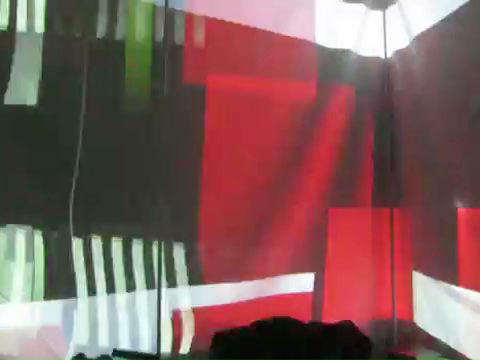
Quickly before you can say boo, the cube is denuded of cling film and fresh tightly wrapped in white ready for Supercell and Bartosz’s orthogonal twin projector visuals. Caleb Madden starts the set with a blistering wail of pure distortion: loud and primal, breaking tones and roaring unstructured fuzz, lovely. Then bang! It drops to four to the floor for at least 16 bars before a reverberant field recording wells slowly around it. It’s an age before further percussion slowly joins and finally some swooping old style hardcore bass buzz. The breakdown sees this noise up into a relentless techno jam before rubber band analogue starts to flip. And then back into noise and bass drum pulses and before you know it, it’s done. I listened to quite a bit of the set from inside the cube surrounded by Bartosz’s Blocks of Red/Black/White/Grey geometra sliding around me. Recommended.
Aigon DAAC
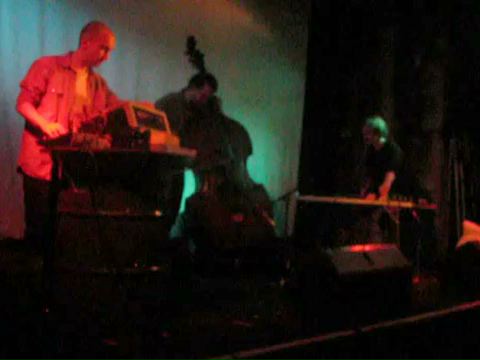
The cube is gone before the final act are ready (on the stage, no less, I doubt they’d think of themselves as orthodox, but there you go). Aigon DAAC start with slowly buzzing double bass drones murking with electronic washes, occasionally shimmering into identifiable synth tones, but often blending seamlessly between the bass and deft cassette manipulation – I can’t say I’ve ever seen such an adept handling of the tapes, proper listening and exact contributions in a quiet very concentrated improvising environment. And as with the best improv hard to describe… There were moments of rich bowed bass, small clicks and sustained quiet feedback; dissonant screeching and at one point the distinct feeling of having a Shuggoth come hurtling at you only to dissipate in mist once it reached the open air. Remarkable.
 Anthony from [beep], playing as Arboria Auralist, turns up late and line checks and seems to be enjoying himself so much he just plays on, lots of toys with indeterminate function. Some look quite expensive and are impressively tactile, some look home-made and make superbly scrungy noises. His set is suitably freeform and, as the lights get dimmed to accommodate the eventness of his playing, a general air of blissing out takes over from the “what is that thing-ness” although the Tenori-on has a delightful pinball kind of visualisation going on for a rhythm part near the end that I find quite engaging.
 Ampism is Paul from Bolide’s solo project, tapes and small synth and effects, its very clean, surprisingly given the source materials, with a nicely constructed sound collage feel. With some proper bass.
 Stereocilia is John Scott and plays a lengthy psychedelic set that starts with synth drones and loops before he switches back to his guitar and arpeggios quite nicely over the top, still keeping the loops and drones going in the background, there is a nice point where the background layers fall away leaving only his guitar picking and he adds in a couple of bass string scrapes that sound like Humpback Whale song and another one where the rain against the window makes the sound of a snare resonating against the skin of a non-existent drum.
 Then Anthony plays his closing set, a more loose affair than the first, even allowing for the way that had started, with people gathered around looking at what he’s up to, but he does get the hydrophone into his glass of beer, which is good, even if it makes me worry about him spilling sticky drops over everything else as he bangs it about on the table. Good. This is what it’s all about.
 I’m Dr Buoyant and Ron Caines have played together a few times now and Tony Rimbaud seems to bring out the best in Ron, giving him the freedom to weave his lines as he wished. At the start Tony started by working on Ron’s sounds, looping and effecting them round. As the set progressed he worked up some more orthodox backing tracks to rumble away under Ron’s improvisations.
 Rounding off the evening Tim Holehouse in collaboration with Ashtoreth. Ashtoreth started by burning a great swathe of Sage in a quite alarming manner before getting to work on his acoustic guitar loops. Tim had some doom-y chords going on under that before they both got into some gravelly vocalising and then twin electric guitars sweep up all the loose ends in the looping stations and Ashtoreth gets back to the acoustic guitar for the finale.
 Andrew Greaves began with a premiere of his piece for organ, ‘Octabeast’. A rare foray into composition for SoG, this was a massively physical performance, with his swift fingers producing relentless arpeggios, the effort becoming increasingly visible as the piece developed. The overlaying echo, and rhythmic pulse which began to introduce itself, produced a kosmische feel. The accompanying visuals were provided by street photographer Simon Peacock, presented in Andrew’s patent flowing slideshow format, and grounded the experience in a way that more spacey images would have failed to do. Watch out for a photographic exhibition from Simon, with the possibility of further collaborations in store, and you can also find a CD of ‘Octabeast’ at our Bandcamp page at
 Set to his trademark film of Soviet space footage, Gagarin’s set eased in with ambient washes and picked out keyboard notes, but soon his mode of more delicate physical performance was introduced. Moving as lightly as Fred Astaire, his hands and feet danced across his pads and keys, always a pleasure to witness. Glitch funk recognisable from his Biophilia CD, nicely pulled apart and played around with live, was interspersed with less rhythmic interludes creating a subtle and nuanced set. The visuals developed into a more abstract, washed out style as things continued, closing with a more robust beat-driven sequence.
 The professionalism of Pawnsphinx’ musical presentation apparently caused some confusion, with some mistaking his set of original pieces for a DJ set. Muscular beats emerged from his laptop, bouncing well-developed drum and synth pads around the venue. He also shared with a bemused audience the bizarre video art of Matthew Barney, from his Cremaster cycle (